

One outdoor unit, or a wall of them
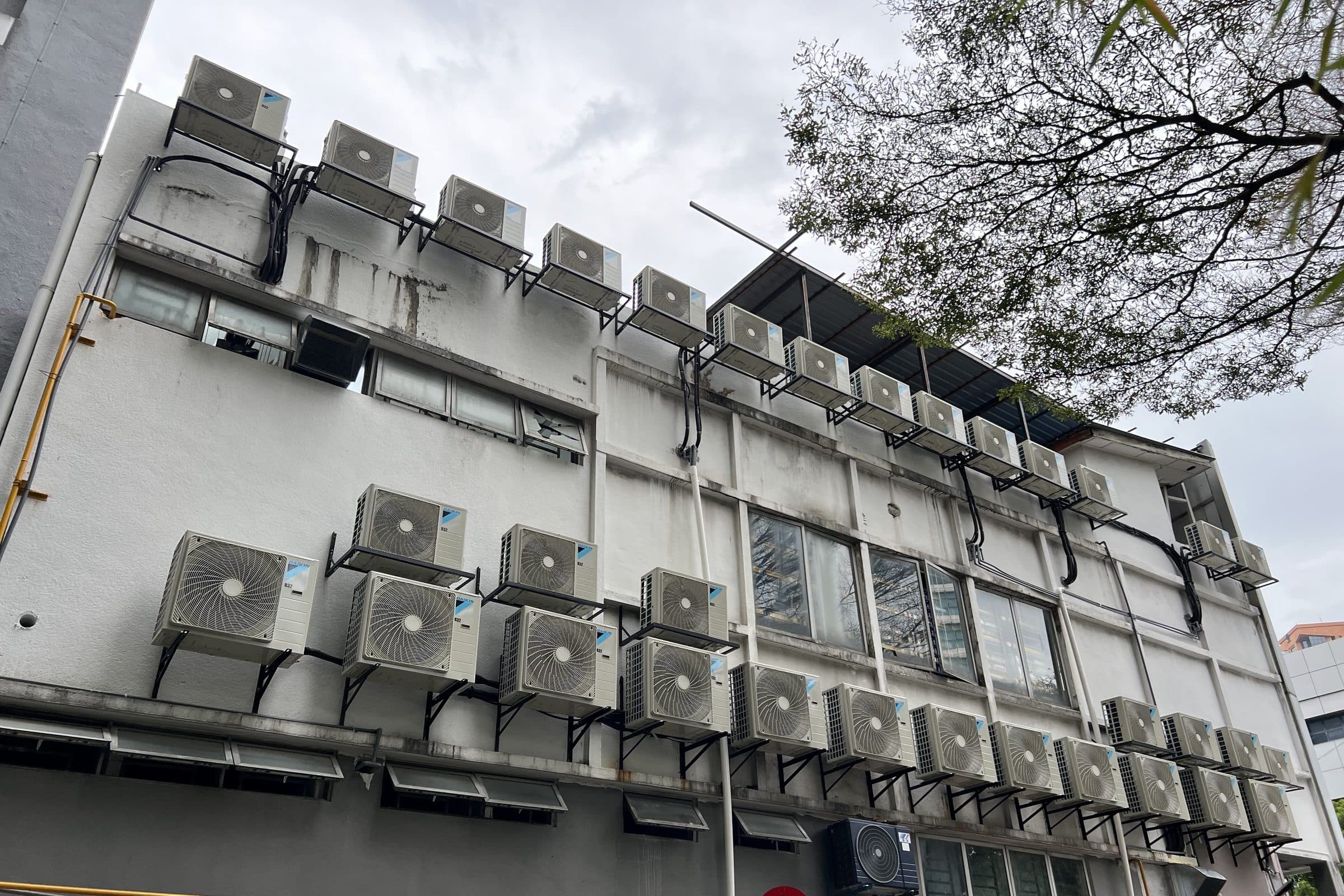
In Malaysia the outdoor unit is usually called the compressor. A split system puts one outside for every room it cools. There is another way to do it: one outdoor unit for the whole house. This guide covers what changes, what you give up, and where each figure comes from.
One per room is the usual way
With split units, every indoor unit has its own outdoor unit. Daikin’s multi-split brochure puts it in exactly those terms: three rooms mean three outdoor units. It is simple and proven, and each unit can be replaced on its own.
The difference shows on the outside of the house. Each room you cool adds another outdoor unit to a wall, a balcony or a roof.
One outdoor unit for several rooms
A multi-split or a VRV system runs several indoor units from a single outdoor unit. In Daikin’s words: “Three rooms only require one outdoor unit.” Daikin’s Home Central brochure takes it to the whole house — living and dining rooms, bedrooms, the kitchen, the closet and the bathroom, all piped to one VRV Home Series outdoor unit.
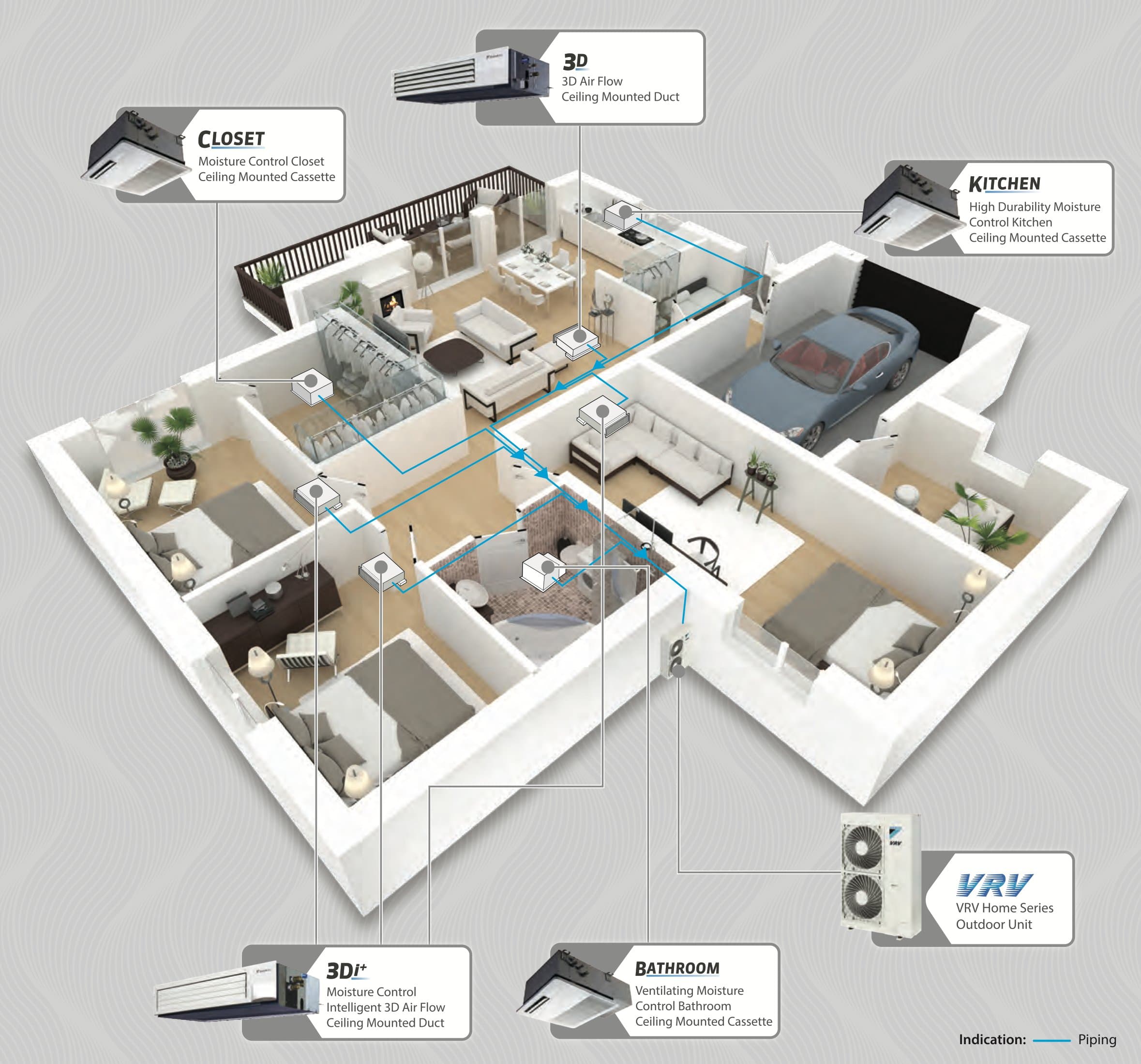
Every room, one outdoor unit. Daikin Home Central brochure (HCAC-0425-E), p. 3.
Why it can be smaller than the rooms add up to
Rooms rarely all run at once. Daikin says so directly: in most family homes the shared rooms are used during the day and the bedrooms at night. So the outdoor unit shares its capacity with whichever indoor units are on.
That is why Daikin lets its S series multi-split outdoor unit connect to indoor units totalling up to 170% of its own rated capacity. Daikin’s example: three split units of 3.5, 2.5 and 2.5 kW need three outdoor units totalling 8.5 kW. The multi-split does it with one 5.0 kW outdoor unit.
That figure is for Daikin’s multi-split. A whole-house VRV system has its own limits, set model by model in Daikin’s data for that outdoor unit.
It spends most of its time at part load
An inverter outdoor unit changes its compressor speed. It runs at full capacity to reach the set temperature, then drops to low capacity to hold it — which, Daikin notes, is how it runs most of the time.
In a month-long Daikin test in Thailand, one 5 kW S series multi-split used up to 30% less electricity than two non-inverter split units. Against inverter single-splits, Daikin rates the multi-split 21% more efficient when only one room is running. These are Daikin’s figures, under Daikin’s test conditions.
Room to breathe
An outdoor unit needs clear air around it. Daikin warns that poor clearance can cause short-circuits or a loss of performance from insufficient air intake, and it specifies a distance to the nearest wall for each model.
On a balcony, Daikin makes the point plainly: three outdoor units leave too little working space; one leaves enough.
Noise
Daikin rates its VRV Home Series outdoor units at 51 to 57 dB(A), depending on the model. Its catalogue measures outdoor sound 1 m in front of the unit, notes that real operation usually runs somewhat higher, and recommends checking the location where neighbours are close. The Home Central outdoor unit also has a quiet operation mode, switched on at installation.
Servicing
Outside, there is one unit to clean and check instead of one per room.
The trade-offs
- One unit serves every room connected to it. If it stops, those rooms stop together. With split units, a fault takes out one room.
- It is bought as one system. The outdoor unit, the pipework and the indoor units are designed and priced together at the start, not one room at a time. What moves that price is set out in our centralised aircond guide.
- It has to be designed before the ceilings close. The indoor units and their pipework sit above the ceiling, so the layout is fixed early.
How we handle it: we measure the house and work out the heat load of each room. Unit positions, pipe runs and the outdoor unit’s position are agreed on drawings before the ceiling closes. The system is tested and commissioned before handover, with the records kept.
Where to go from here
- What “centralised aircond” actually means, and when it suits a home: the centralised aircond guide
- The short comparison: centralised vs split aircond for home
- Daikin Home Central, designed and installed by CASS: our Daikin PROSHOP page
Sources
- Daikin, Multi-Split Type Air Conditioners, S series (MKC-0520-C), pp. 1–4, 7–8.
- Daikin, Multi-Split Type Air Conditioners (MKM-0520-C), pp. 9–10, 13–14.
- Daikin, Home Central Air Conditioning (HCAC-0425-E), pp. 3, 16–17, 26.
- Daikin, VRV General Catalogue (VRV-1025-K), pp. 37–38.